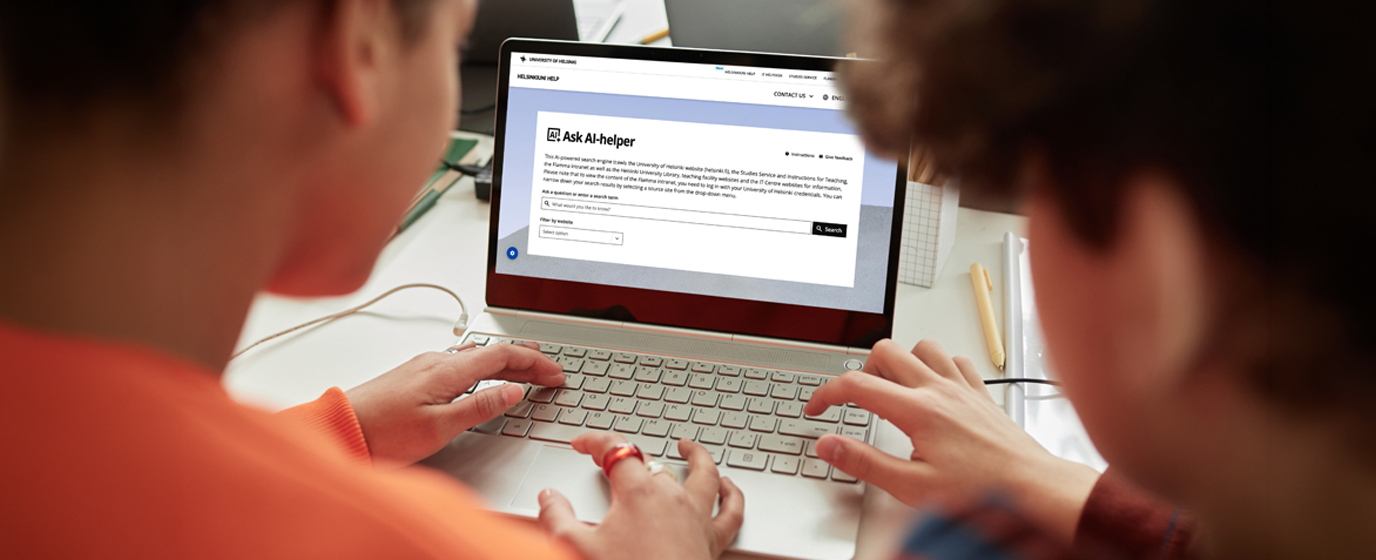
About the Client
The University of Helsinki is one of Northern Europe’s oldest, largest, and most prestigious academic institutions. Operating across three official languages—Finnish, Swedish, and English—it serves a vibrant community of 35,000 students as well as thousands of teachers, researchers, and administrative staff.
The Challenge: The High Cost of Confusion
Every university has an endless supply of content: policies, curriculum guides, facility booking rules, and IT FAQs. However, having content does not guarantee access. When students are forced to hunt through complex site navigation or wade through outdated PDFs, the system breaks down. They get confused, clog support desks with emails and calls, or simply give up.
”The organisations and universities that will win this race are not the ones with the most content—they are the ones that actually use clarity as infrastructure. It’s a competitive advantage that becomes more and more valuable every day.”
In a university setting, the financial and operational costs of confusion are immense. Every unanswered question builds a queue at an already overloaded service desk. More importantly, the stakes are high: if a student misses a deadline or files the wrong form due to poor search results, it directly impacts their academic journey. Similarly, staff members waste hours locating accurate information—meaning less time spent on actual research and teaching.
Traditional search setups fail because they present a list of “blue URL links” rather than a direct, natural response. When Mearra stepped in, the university’s knowledge base faced major hurdles:
- Severe fragmentation: Critical information was scattered across seven distinct upstream platforms, ranging from internal intranets to public-facing websites.
- Content quality drift: Because different departments managed separate portals, it was impossible to maintain a consistent tone of voice or verify that outdated data had been removed.
- The access problem: The knowledge existed, but there was no intuitive way for users to extract immediate, reliable answers.
The Solution: UX First, Always Trustworthy
Mearra shifted the conversation away from traditional Content Management System (CMS) workflows. Instead of building better navigation menus, the team designed a UX-first answering machine called Uni Help.
”HelsinkiUni Help is a new customer service model implemented over the past year, where the website built by Mearra with its AI helpers is part of the whole. In this service model, first-response customer service is centralized into a new organization that responds to service requests via chat, live service desks, and emails flooding into the customer relationship management system. The AI helper is part of this entity and operates within it as a whole; the greatest benefit of the AI helper is that it is intended to reduce pressure on those other channels of the service model. If information is easily found through the helper, it will no longer turn into a service request.”
Delivered in an intense three-month sprint, the solution prioritises a Trust Infrastructure—ensuring the university can proudly stand behind every response generated by the AI.
1. The Trust Architecture
To prevent hallucinations and build student confidence, the system relies on three strict algorithmic and UI parameters:
- Verified references: Every AI response includes a structured references array containing the exact title and URL of the source material used to build the answer.
- The “has information” circuit breaker: The Large Language Model (LLM) is required to return a boolean field confirming whether it actually has enough context to answer. If confidence is low, the AI summary is automatically hidden.
- Hybrid search processing: Below the AI-generated paragraph, the UI displays traditional lexical search cards so users can manually inspect the source documents.
2. A Light and Intelligent Technical Stack
The system acts as an automated self-service desk without storing massive duplicate data frameworks inside the CMS. Instead, it relies on a lightweight, decoupled stack where each component has a precise role:
- Orchestration (Drupal): Manages data pipelines via Drush commands, handles permissions, runs cron jobs, and configures feature flags or kill switches.
- Search engine (Elastic Search): Combines vector-based semantic search and traditional lexical (BM25) phrase matching into a single fast query.
- Microservices (Node.js/Fastify): Runs lightweight, low-cost algorithms for query rewriting, instant language detection, and intent analysis.
- AI intelligence (Azure OpenAI): Generates structured answers verified against strict JSON schemas directly on the provider’s side.
”The solution is part of the initial impetus for a service model transformation, and the work around it continues. Customer-centric thinking, making it easier to find instructions by utilizing AI, and centralizing different human contact methods into the same service channel bring the desired clarity to the service jungle for students, staff, and applicants.”
To keep the system fast and reliable, every question flows through a seamless loop—the Query and optimisation lifecycle—that connects the end-user directly to administrative oversight. A user enters a search query, which instantly passes through Node.js for a rapid language and intent check. Next, Elastic Search runs a hybrid scan to pull the right documents and feeds them to Azure OpenAI to safely generate a structured, verified answer. Finally, this search data loops directly back into the Drupal Management UI, allowing administrators to review user trends, catch content gaps, and continuously optimise the university’s source content.
3. Smart Linguistic Routing
If a student types an English query into a Finnish user interface, a fast, low-cost algorithm catches the intent before it ever reaches the LLM. It instantly displays a contextual call-to-action that smoothly transitions the user to the correct language profile.
The Results: Proactive Information Infrastructure
Uni Help has completely redefined how the University of Helsinki views its digital presence. By treating clarity as actual infrastructure, the solution delivers long-term organisational value.
The Ultimate Admin Feedback Loop
The platform bridges the gap between end-user behaviour and internal content creation:
- AI-generated analytics: Rather than forcing administrators to decipher complex rows of raw data, an LLM scans search trends and anomaly patterns to deliver a written summary of daily user behaviour right inside Drupal.
- Automated Slack alerts: Every morning, the communications team receives a Slack notification detailing usage volumes and emerging search themes.
- Crowdsourced data verification: Students can flag discrepancies using a “Report an issue” button directly on the AI summary. This action automatically populates a moderation queue in Drupal, letting administrators fix underlying source materials immediately.
Finding Knowledge Gaps
The platform has sparked an entirely new internal conversation. If students ask questions that the current documentation cannot answer—for example, “What is a good job to get while studying here?”—the admin dashboard highlights the void. Instead of guessing what content to write, the university can now use real-time search intent data to build an accurate, proactive knowledge base.
What required the most careful thinking was always the same thing: the information architecture underneath. Who actually owns this content? Not on paper—in practice. How current is it, really? How do you know? How does the user know?
And perhaps the most uncomfortable question of all: does the answer even exist in your content? Because if it doesn’t, no amount of AI can deliver it. And then: what happens when the system gets it wrong? Because it will, at some point. The question is whether you’ve designed for that moment or just hoped it wouldn’t come.
This is what we mean when we say AI search is an organisational challenge as much as a technical one. The AI is the easy part. The hard part was always there—it was just easier to ignore before. Gladly, even the hard part is not hard for us; especially when having close and fluent collaboration with the client.
”The collaboration was easy, smooth, and straightforward. The team worked well together, things progressed as agreed, and communication was transparent and natural. It was a well-managed, professional team—throughout the entire project, there was deep trust that things would get handled and that what was agreed upon would be delivered.”