The roadmap for our agentic AI future at Mearra is clear for our operations and how we help our clients with it. Or, more precisely, it’s clear for now. That may change at any time next week. AI evolves, and we evolve with it. As the founder and CEO of Mearra, I do my best to share our AI vision with clients and other stakeholders in this article.
Digital development is facing a fundamental change in how the business works. Also, our core business model is changing, our team structures are changing, and the daily work of most of our staff is changing. It’s almost easier to list what isn’t changing: we help our clients improve how they work, supported by software.
The big change is the pace. Things that used to take years can now happen in weeks. Increasingly, we are waiting for people and organisations to adapt. Software is no longer the slowest-moving part of the equation.
As consultants, we are used to change. That’s where we’ve always lived. So for us, this means picking up the pace and completely revamping how we work. Business as usual.
For our clients, the transition is typically more challenging. They need to adjust to a very different pace while keeping their businesses running.
Mearra’s approach to the agentic era
Simply adding AI to existing processes will not help much; it typically gives you a marginal boost and moves the bottleneck elsewhere. This is why we started, in our own business, by creating a new process model: The Mearra Method.
At the same time as process updates, it was time to update the way teams work with our clients. A lot of AI adoption was already done at our end, and different teams were working in different ways. These variations in practices also started to cause a lot of problems. Was permission for AI use in something already asked from the client? Did every developer know how to securely run agents inside containers? Were EU-hosted models part of the DPA if personal information was handled with it? And so many other important and relevant questions that urgently needed answers.
It was time to move beyond AI pilots and only tool adaption, we wanted to scale this to every team, every client and every employee.
To address this, we created an agentic maturity model for teams. This means setting artificial limits on what can or can’t be done with AI in a team. It makes communication much easier by clearly setting expectations for which tasks are done by humans, which are AI-assisted, and where agents either assist or take the lead. While this does reduce the team’s flexibility to adopt AI, it also adds safety and clarity around how they work.
We’ve built similar maturity models for clients; the model will be different for each organisation. I’m using our own model here as an example.
Levels in the maturity ladder
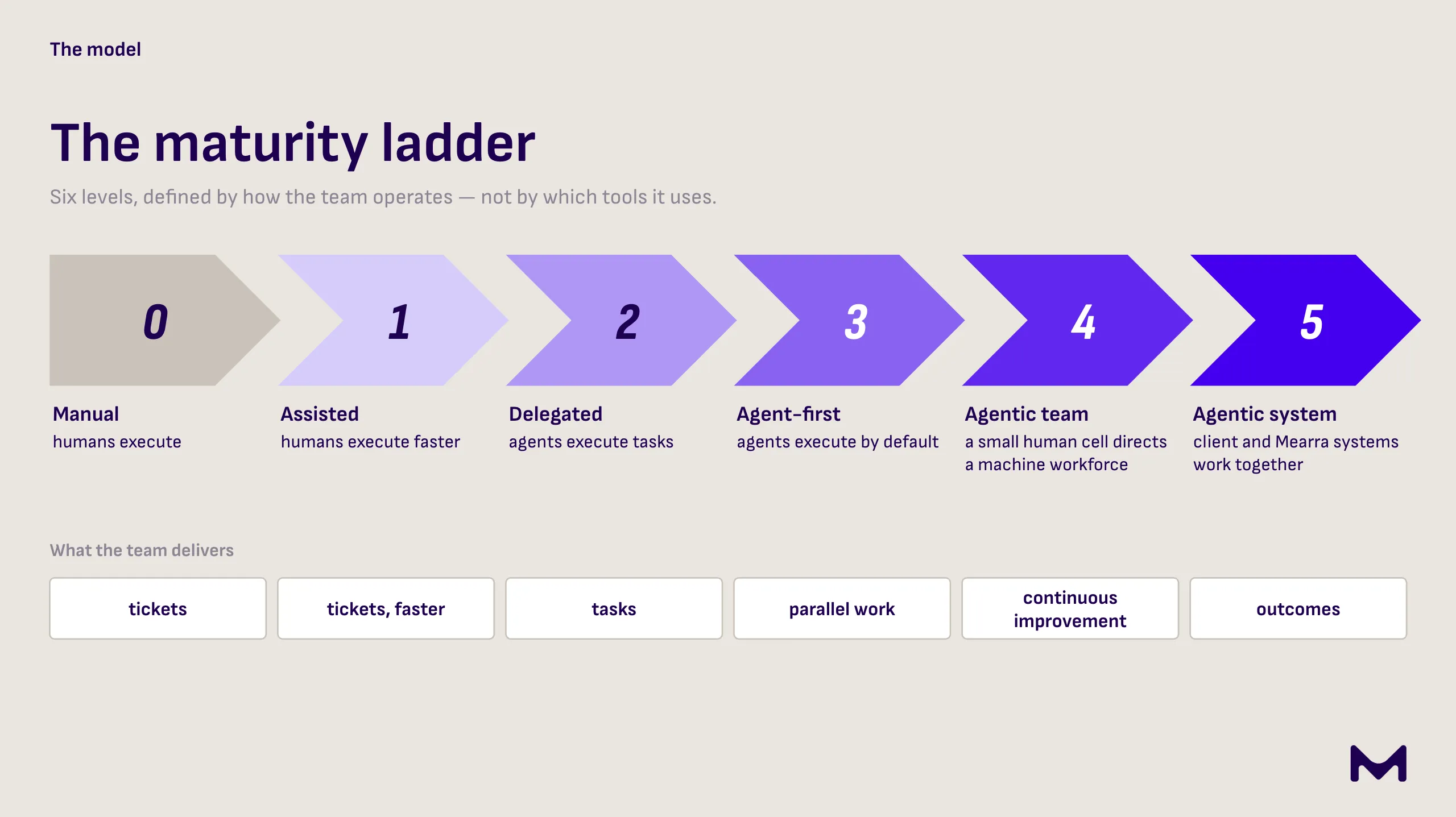
Our current ladder has one + five levels. The very first level is Level zero: the manual era before AI. Levels one onward are AI-assisted or agentic. There will very likely be more levels to the ladder later. Actually sooner than later, if I had to guess.
Level one: AI-assisted work
On this level, humans execute work faster with AI assistants. This is developer’s Copilot doing a bit of testing and helping at the coding level. Speed and quality both go up, and bottlenecks in the process start moving elsewhere.
This level doesn’t require permission from any client; it’s purely our own internal tooling, separate from client systems. Anything produced stays secure; no work is used to train models. Some training and compliance is still required for the team; they need to know how to handle secrets or personal data securely. In most cases, LLMs are not GDPR compliant; they would need to be in the EU and added to the privacy policy as data handlers. Most organisations will likely want to avoid that.
Level two: Delegated work
Agents execute clearly defined tasks; humans verify. At this level, creating software becomes much faster; the bottleneck clearly moves to verification. Reviewing designs and code is much slower than implementation.
As a side effect, quality starts to increase noticeably at this level. Having full test coverage becomes very affordable. Human time shifts to more valuable work. At this point, every human becomes a manager of a herd of agents.
This level already requires material changes to the way teams work. Entire professions start to disappear as well; some tasks are no longer suited for human work at all. With our current experience at this level, most humans can still find other suitable work that’s close enough to their previous job.
For the first time, secure tooling becomes very important at this level. Agents can’t run with the same permissions humans do; if they do, they’ll eventually cause problems. Containerised environments must be deployed for agentic tasks to ensure the permissions agents have are clearly separated from those humans have.
Level three: Agent-first
At this point, every human truly becomes an agent manager. The job starts to change much more drastically. The process models adapt to help remove new bottlenecks. Humans no longer do detailed code reviews; they become more focused on overviews and guiding the architecture.
In our line of work, the bar for software produced is increased drastically. Any software produced will be extremely fast-performing, technically flawless, and excellent to use. Many more individual workflows are supported in the software; it’s no longer a single user interface for all users, and it can be heavily tailored per team or even individual user. Some web apps become native software run on computers and mobile devices. It’s typically not more features or software; it’s better software.
The team sizes shrink quite a bit at this level, and all job roles change again, some even radically. Communications is the new bottleneck. The process model must shift decision-making to someone else to reduce that bottleneck. If decisions are made as they have always been, the work is blocked almost all the time. Finding a reliable way to ensure efficient communication and seamless collaboration between humans becomes more critical than ever.
Existing tooling can still largely be deployed for tooling to support this way of working. The cost of that tooling will start to increase very rapidly. It’s not only AI token cost; it’s also things like GitHub Actions being used 10x more than before. Your entire infrastructure will be under much more load than ever before; some of this will drive new costs.
Level four: Agentic team
At this stage, agents gain much more autonomy. Lead agents guide herds of implementation agents. Agents run 24/7. A smaller number of humans work together with lead agents to guide the work in the desired direction. A quality assurance harness keeps the product in great shape with minimal human oversight.
Communication can’t rely only on humans at this point. Agents need to have access to a knowledge graph on the topic they are working on. The graph is basically a vector database of all the information on the topic they are working on, enabling them to make better, more independent decisions.
With work ongoing 24/7, human work also needs to keep up. It often makes more sense to spend the first hour of the day just answering the questions lead agents have. They make many rapid-fire decisions in quick succession.
Tooling is rapidly changing because traditional coding tools no longer work with agentic teams. Agents can’t be run in local containers because they need to be online 24/7. Cloud capacity is also needed for the containers the agents run in, not just the AI tokens.
Level five: Agentic system
Agents get a lot more autonomy with a decision framework on things they can decide on their own. Knowledge graph gains the ability to instruct agents on where the limits of their decision-making end. Typically, the graph also starts connecting to other graphs, and agents get an exponential amount of info for independent work.
Traditional 9-17 workday begins to unravel. Humans talk to lead agents every morning, afternoon and evening. Human team members get a lot more freedom in how to set their daily schedules, but the day also isn’t contained to office hours.
We’ve only been able to pilot level five in production with tiny teams consisting of some of our management team members. It provides massive boosts in productivity, but it’s not exactly compliant with traditional ways of working or employment contracts. The benefits are still quite clear over level four, where we stick to more traditional models; currently, this seems to be the direction the world is headed: smaller, much faster teams working without the constraints of the traditional workday.
Beyond the five levels
As of writing our own model, levels four and five are not widely spread. They require quite a bit of change in how the team works, often at a level that’s not fast on either our or the client’s side. Levels four and five are still in flux; they will be implemented better and better with the same principles. Level six is around the corner, likely still in 2027.
Our 0+5 ladder model also has a way to deal with disruption in the organisation when teams are at different levels. Some of this is more traditional change management for internal stakeholders. There will always be FOMO when teams operate at different levels, and that has to be addressed. But it’s just as important to do a controlled rollout as teams move from level to level; without it, mistakes will happen from time to time. Some of these can be really costly for the organisation.
We don’t have a crystal ball, so we don’t speculate on the future levels. It’s just clear that there will be many after our current model ends. In the following chapters, I will still do my best to give as accurate a vision as possible.
Splitting the work between a human and an agent
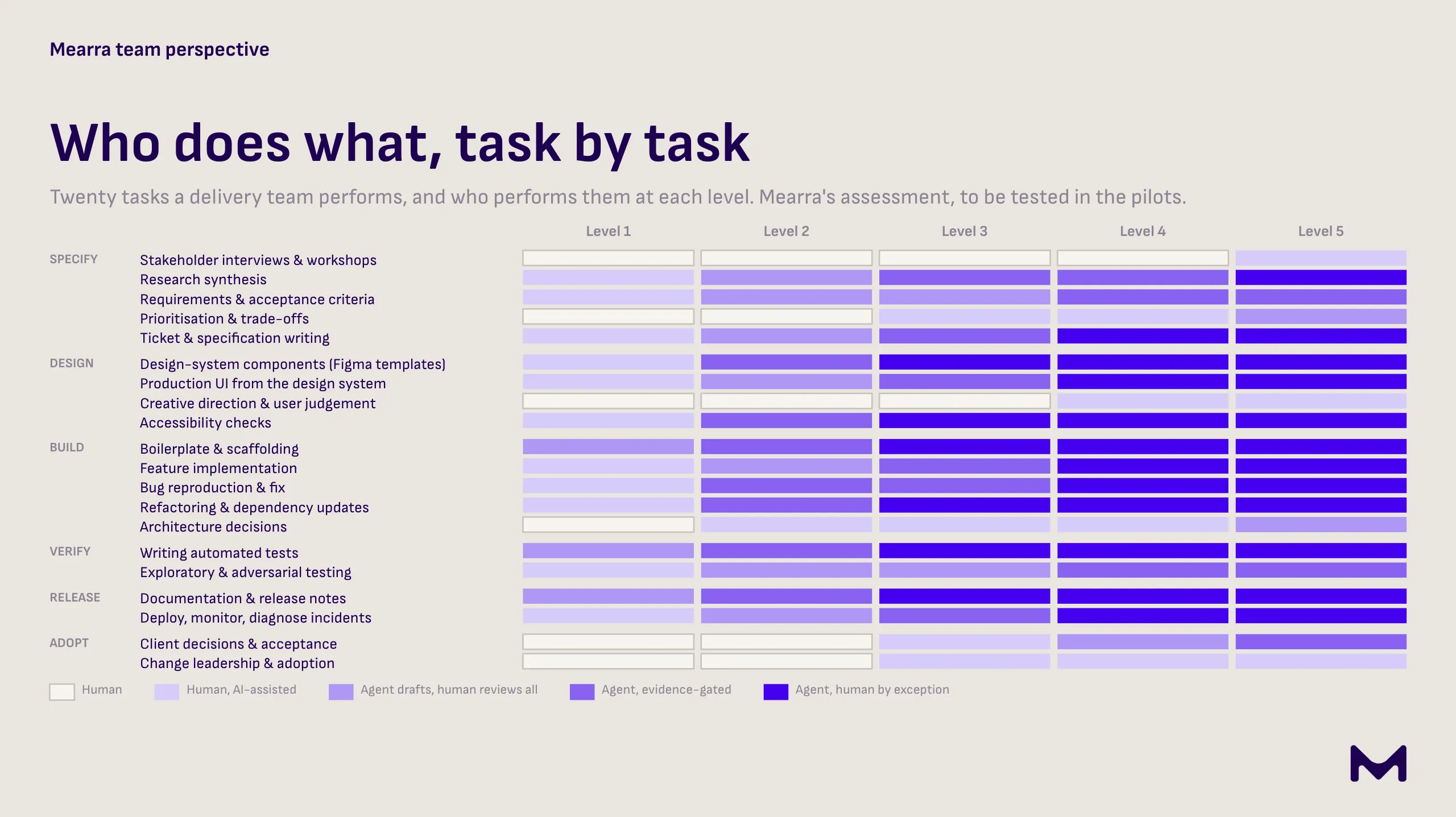
The split of work between humans and AI will differ for every organisation. This is our first iteration of the split per level. I’m not sharing our latest version to retain our competitive edge in the industry; it has evolved considerably from this one. And this is still enough to share the basic idea; every company has to adapt this to their teams anyways.
It’s important to make it clear what work belongs to humans, what’s assisted and what belongs to an agent early on. Human team members need this information. It can also be a binding contract between a vendor and a client. Boundaries of where humans are involved vs what’s in the agentic realm.
The table above includes just some of the tasks a company like Mearra does. It’s good to create a comprehensive table with AI help. Then discuss it with humans, paying close attention to detail. Because this should become a binding contract between all teams in the organisation, what’s allowed at each level.
Work humans should no longer do
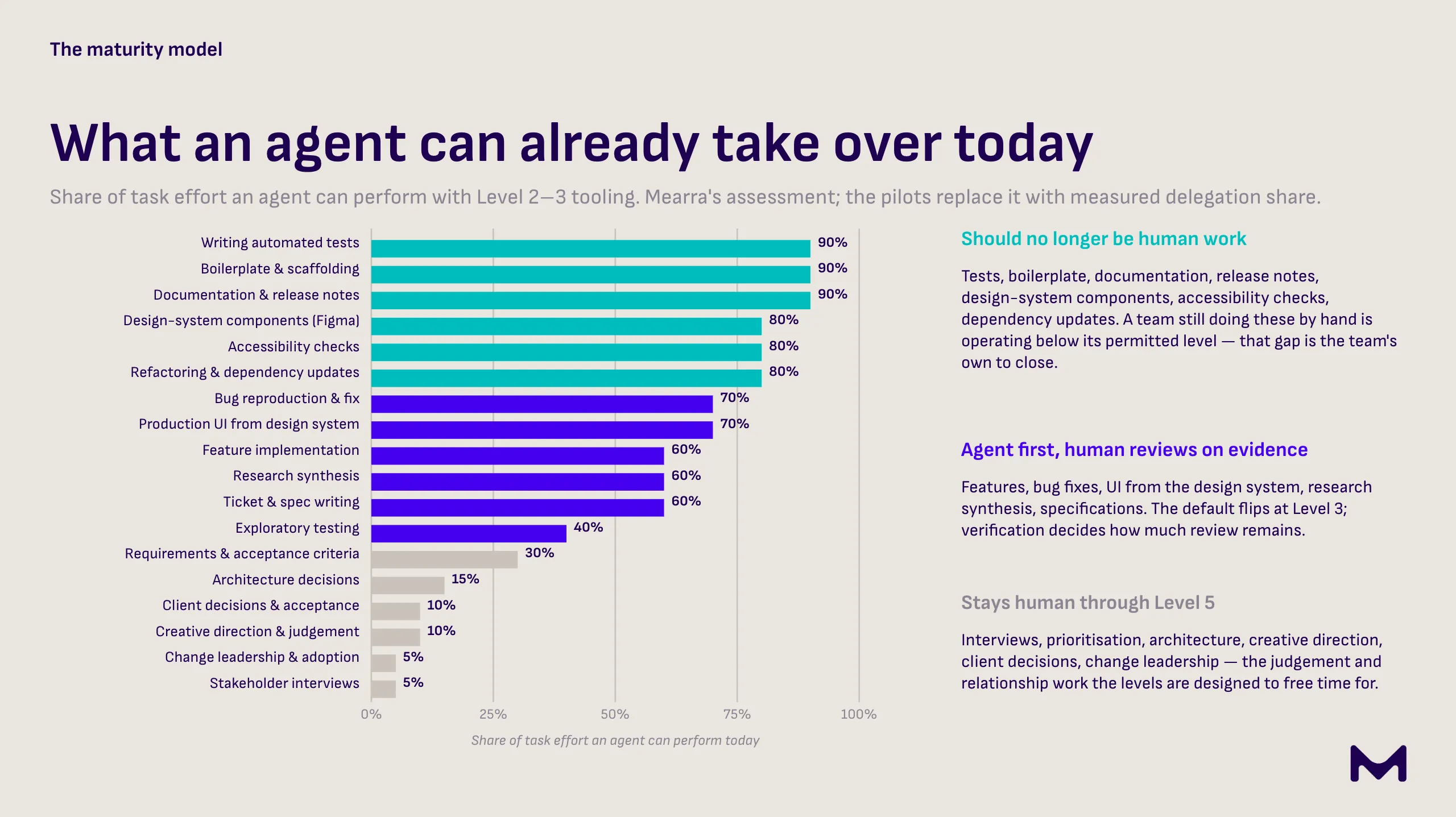
We already have many tasks in 2026 that aren’t well suited for a human. And this is only in our industry; your industry may have quite different tasks. There is no excuse for humans to be working on many of these tasks today; AI is simply much better at them.
Identifying these tasks is one thing. Considering what to do with people focused mostly on them is another one. In an ideal situation, another task is available for them, and they can move on. There is also an option to upskill them to another job. This will not be an easy transition for everybody, and we don’t have easy answers. It will, however, be one that many managers and leaders will have to consider in the next 6-24 months.
Unfortunately, this is also a moving target. As AI and the tooling around it improve, the work humans should no longer do keeps evolving. In the longer term, we trust people will move on to tasks that create even more value. But we can’t pretend there wouldn’t be a dip before that happens. Just like the Industrial Revolution, this AI revolution is likely to take jobs first before it ends up creating them and eventually improving quality of life for everybody.